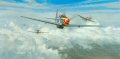
| | Item Code : DHM2596 | Fighting Red Tails by Robert Taylor. - This Edition | |
| | TYPE | EDITION DETAILS | SIZE | SIGNATURES | OFFERS | YOUR PRICE | PURCHASING | | PRINT | Signed limited edition of 800 prints.
| Print paper size 33 inches x 23.5 inches (84cm x 60cm) |  McGee, Charles McGee, Charles 
Hudson, Elbert
Steward, Lowell
Sherman, Arthur
Walden, Leon
+ Artist : Robert Taylor
Signature(s) value alone : £200 | £50 Off! | Now : £215.00 |
|
| | General descriptions of types of editions : |
|
|
|
|
|
|
| Signatures on this item | | *The value given for each signature has been calculated by us based on the historical significance and rarity of the signature. Values of many pilot signatures have risen in recent years and will likely continue to rise as they become more and more rare. | | Name | Info | 
Colonel Charles McGee (deceased)
*Signature Value : £55
| Charles McGee graduated from flight school and shipped out to Italy in December 1943 as a flight Lieutenant in the 302nd fighter Squadron, 332nd Fighter Group. He flew missions in North Africa, Italy and Germany, and got his first victory on 24th August flying escort in the Ploesti oil field raid. After the war this outstanding flyer commanded fighter squadrons throughout the United States, Italy, the Philippines and Germany, logging up more than 6,100 hours in 409 combat missions spanning World War II, Korea and Vietnam. Serving in the armed forces for 30 years he holds the record of flying more combat missions than any other USAF pilot in history. Born in Cleveland, Ohio in 1919, Charles MeGee, who was to become a Command Aviator who would fly combat missions in three different military conflicts, spent his childhood in Ohio, Illinois, and Iowa. Following two years attending the University of Illinois, WW 11 began, and McGee was sworn into the US Army enlisted reserves on October 26, 1942. He was accepted for pilot training in November and entered the Army Air Corps Aviation Cadet Training Program. McGee earned his wings and was commissioned as a Second Lieutenant in June 1943, as a member of Class 43-F at Tuskegee Army Air Field. He was assigned along with many of the other black pilots who had earned their wings at Tuskegee to the 332 nd Fighter Group in Italy. With the 302nd Fighter Squadron McGee trained in the P-40 and would later fly more than 82 tactical missions in the P-39. His fighter group was then transferred into the Fifteenth Air Force and he first flew the P-47 and several weeks later the P-51 Mustang. In this duty, along with other 'Tuskegee Airmen,' McGee performed admirably surmounting many of the unfortunate hurdles placed in their path. The Tuskegee Ainnen became known for their superlative effort at protecting allied bombers from attacking German fighters. McGee is credited with downing one Fw- 190, and the destruction or damage of many others on the ground. He became a flight leader, was promoted to Captain, and after flying 54 more combat missions, returned to Alabama as a twin engine flight instructor. In 1950 McGee flew 100 more combat missions with the 67th Fighter Bomber Squadron of the 18th Fighter Group. He was then made Commander of the 44th Bomber Squadron flying out of Clark Field in the Philippines. Later he would serve with an F-89 Interceptor Squadron, and following a number of interesting operational and staff assignments he would serve as Commander of the 16th Tactical Reconnaissance Squadron deployed in Vietnam. In his year in Vietnam, McGee would fly another 173 missions. Later assignments included Air Liason Officer for USAEUR and 7th Army, Chief of Maintenance for the 50th Tactical Fighter Wing, Director of Maintenance Engineering for AF Communication Service, and Commander of Richards-Gebaur AFB, and the 1840 Air Base Wing. He retired from the USAF in 1973 with 6,300 flying hours, including 1,100 hours flown on fighter combat missions. Col. McGee earned a BA Degree in Business Administration and worked for many years in the real estate business with ISC Financial Corporation. He also served as Director of Administration forthe city of Prairie Village, Kanasas, and as Manager of the downtown Kansas City Airport. Now fully retired Charles lives with his wife, the former Frances Nelson of Champaign, Illinois. The McGees have three children, ten grandchildren, and five great grandchildren. His numerous decorations include the Legion of Merit with one cluster, the Distinguished Flying Cross with two clusters, the Bronze Star, the Air Medal with 25 clusters, the Army Commendation Medal, the Air Force Commendation Medal with one cluster, a Presidential Unit Citation, and the Korean Presidential Unit Citation, to name only a few. He died 16th January 2022. | First Lieutenant Arthur Sherman
*Signature Value : £40
| Arthur Sherman joined up as soon as he could on 10th April 1942, and after training was posted to the 15th Air force in Italy, joining the 779th bomb Squadron, 464th Bomb Group flying B25s. He flew his first combat mission on 2nd May 1944. Transferring to the 483rd Bomb Group he flew B17 Fortresses and was regularly escorted by the 332nd Tuskegee Fighter Group. Among his numerous strategic bombing missions were included the momentous raid to Memingen airfield to destroy the factory where over 600 Me109s were being made every month, together with the new Me262 jet fighter. | Second Lieutenant Elbert Hudson (deceased)
*Signature Value : £45
| In September1942 Elbert Hudson joined up and went for pilot training at the Tuskegee Flight School, graduating as a fighter pilot on P51Bs. He soon found himself posted to the 332nd fighter Group in Europe, where he undertook his first of many combat missions in June 1944. Elbert flew with the 332nd escorting bombers on 23 combat missions in the Mediterranean theatre of operations right through until the end of hostilities in May 1945. After the war, he opened a private law practice in 1953 and over the course of his legal career represented many individuals, businesses and organizations in the Black community. He also mentored several young Black attorneys who worked in his office and who went on to become judges. In his later years, Al provided pro bono legal services to seniors at the Estelle Van Meter Multipurpose Center in South L.A. He was inducted into the Langston Bar Association Hall of Fame and was recognized as a Distinguished Alumnus by Loyola Law School. In 1961, Al was appointed to the Los Angeles Police Commission. He was serving on the Commission during the Watts Rebellion in 1965 and played an important role in working with the Police Department to improve police-community relations. During his tenure on the Commission, Al became its first Black President. Former Police Chief Bernard Parks remembered Hudson as a trailblazer and role model. | 
Second Lieutenant Lowell Steward (deceased)
*Signature Value : £30
| Entering the Tuskegee flight school for training in July 1942, Lowell Steward graduated as a fighter and was sent to Italy in 1944 with the 100th Fighter Squadron, 332nd Fighter Group. From Capodichino Air Base in Naples he flew a number of missions in Bell P-39 Airacobras and Curtiss P-40 Warhawks. He was subsequently based in Ramitelli Airfield where he flew many more missions in North American P-51 Mustangs. In total, he flew 143 missions and remained in the service until July 1946. After the war and upon his return to Los Angeles, he helped to organize the Los Angeles chapter of Tuskegee Airmen, Inc. and to found a scholarship foundation in the name of the Tuskegee Airmen. In 2007, Steward attended President George W. Bush's presentation of the Tuskegee Airmen with the Congressional Gold Medal. On December 14 2014 Lowell came down with a cold that led to pneumonia and sadly died on December 17th in the Community Memorial Hospital of natural causes at the age of 95. | Staff Sergeant Leon Walden
*Signature Value : £30
| Joining up in November 1942 Leon Walden trained to become a waist gunner on B17 fortress, being posted to Europe, joining the 840th bomb Squadron, 483rd bomb Group in Italy. Going into combat on 12th April 1944, Leon flew 50 combat missions with the 483rd, including the heroic raid on the Me262 jet fighter factory at Memingen Airfield on 18th July 1944, when the group was attacked by a force of over 75 Luftwaffe fighters. |
| The Aircraft : | | Name | Info | | Mustang | The ubiquitous North American P-51 Mustang, which many consider to be the best all-around fighter of WW II, owes its origins to the British Air Ministry. Following Britains entry into WW II in 1939, the RAF was interested in purchasing additional fighter aircraft from American sources, particularly the Curtiss P-40. Curtiss, which was busy, was unable to guarantee timely delivery so the British approached North American Aviation as a possible second source for the P-40. North American chose to propose its own fighter design which would use the same Allison engine as the P-40. Utilizing new laminar flow wings, the North American fighter was expected to have performance better than the P-40. Developed in record time the new aircraft was designated as a Mustang I by the Brits, whereas the USAAF ordered two for evaluation which were designated XP-51 Apaches. Intrigued with the possibility of using this aircraft also as a dive bomber, North American proposed this to the USAAF which decided to order 500 of the P-51 aircraft to be modified for dive bombing use. Designated as the A-36 Invader, this version of the Mustang utilized dive flaps, and bomb racks under each wing. Some reinforcing of the structural members was also required because of the G-forces to be encountered in dive bombing. A-36s entered combat service with the USAAF prior to any P-51s. In early 1943 the 86th and 27th Fighter Bomber Groups of the 12th Air Force began flying A-36s out of Northern Africa. Despite some early problems with instability caused by the dive flaps, the A-36 was effective in light bombing and strafing roles. It was not, however, capable of dog fighting with German fighters, especially at higher altitudes. Despite these drawbacks one USAAF pilot, Captain Michael T. Russo, who served with the 16th Bomb Squadron of the 27th Fighter Bomber Group, was credited with five confirmed aerial victories in the A-36, thereby becoming the first mustang ace. |
|
|